

|
|
|
What makes humans the dominant animal species on the planet? Much of the popular literature has emphasized similarities between humans and our closest animal relatives, especially the chimpanzee. But there can be no doubt that humans are special. A major human cognitive specialization is our ability to process conceptual information. We are able to form abstract concepts by combining sources of information and generalizing from current knowledge. These concepts can be invoked in the absence of immediate percepts and used to recognize exemplars not encountered before (e.g., recognizing a basset hound as a dog even after only encountering beagles in the past).
To understand how our brain evolved the ability to process such conceptual information, we need to know what anatomical specializations occurred to allow this behavior. We still know little, but damage to the anterior temporal lobe in humans produces disruption to the production and manipulation of abstract concepts. We also know that the anterior temporal lobe has disproportionately expanded in the humans since our divergence from old world monkeys and that its connections with other parts of the brain have proliferated.
Therefore, the goal of the Marie Curie project "Does the temporal cortex make humans special? What comparing the human and great ape brain can tell us about cognitive evolution" is to investigate which anatomical specializations have developed in the human brain, compared to that of our closest animal relatives, and whether these are involved in the uniquely human ability to process conceptual information. We use a combination of neuroimaging techniques to investigate the organization of the human, chimpanzee, and macaque brains to identify parts of the temporal cortex that are unique to the human brain. Then, using functional neuroimaging in the human volunteers, we test whether this unique area is indeed activated when people engage in the processing of conceptual information. Together, this presents a unique opportunity to study human uniqueness in a combined comparative and psychological project.
This project is a Marie Curie Fellowship awarded to Katherine L. Bryant and is hosted by the Donders Institute for Brain, Cognition and Behavior. The supervising PI is Rogier B. Mars, who heads the Cognitive Neuroecology Lab.
The first goal of the project is to identify whether the human brain really is differently organized than that of other species. That it is different from the macaque brain in many respects is well understood, but how different we are from our closest animal relatives--the chimpanzee--is mostly unknown.
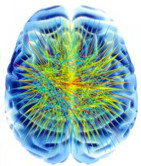
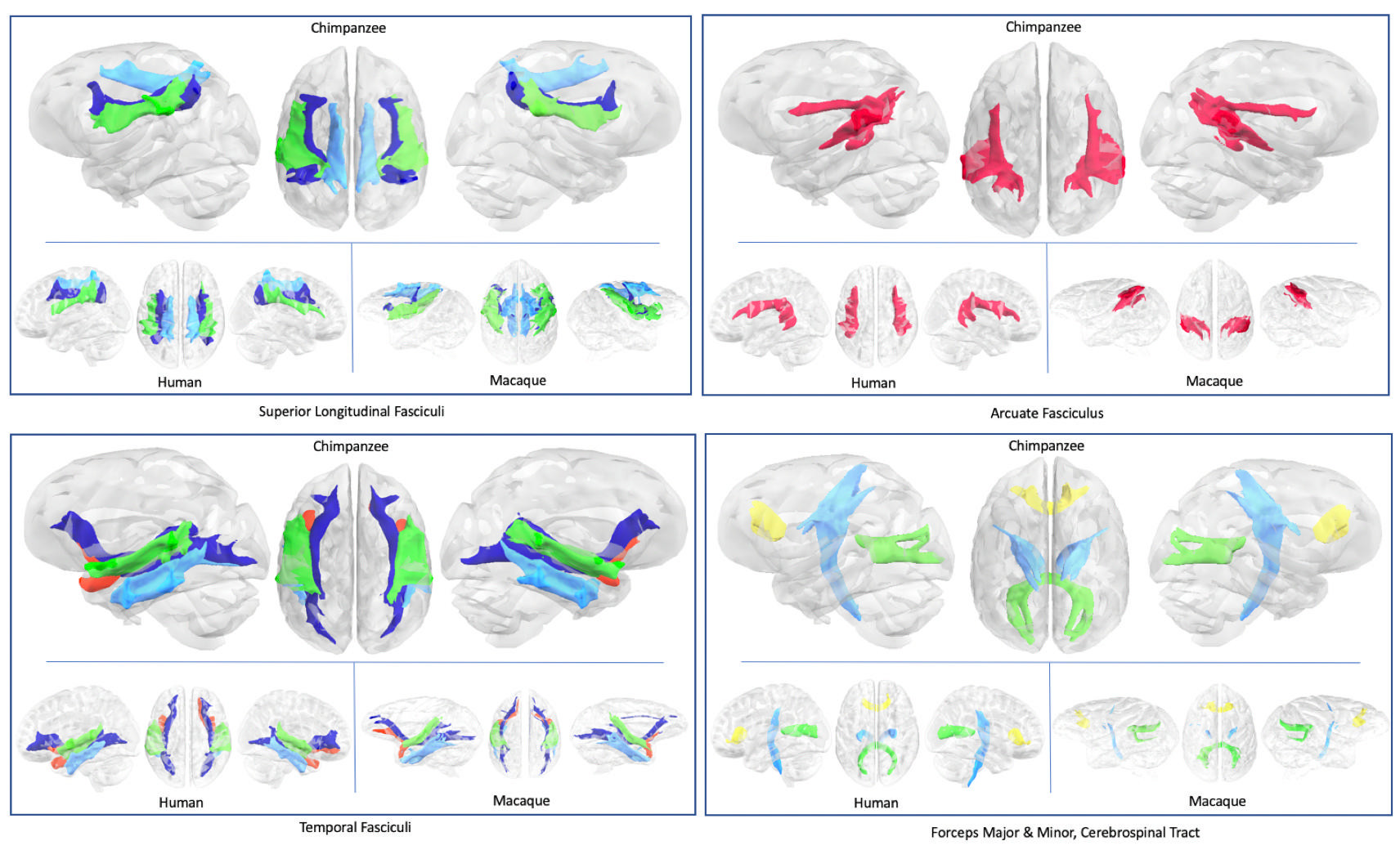
Therefore, we created an atlas of the brain connections of the macaque, the chimpanzee, and the human. These connections were reconstructed using diffusion MRI, a non-invasive technique that allow visualization of the brain's white matter. The figure below shows some of these tracts. We showed that temporoparietal cortex in the human differs from that of the macaque, but also from the chimpanzee. This provides the anatomical basis for some of our unique abilities.
How does the human brain do it?
Having established that the human brain, in particular its temporoparietal cortex, is different from that of other species, the question remains how these unique parts work. We have hypothesized that the human temporal cortex is particularly good at constructing narratives. In other words, it is able to form associations between events that unfold over long periods of time. This is in contrast to how most animals see the world, as they focus mostly on events present together in space and time.
In a series of experiments, we are probing the activation of the temporal lobe while human volunteers present conceputally demanding tasks. We probe their brain activation using functional MRI.
In one experiment, we asked healthy human volunteers to watch videos that differ on their narrative content. Our hypothesis is that the parts of the human brain that are uniquely human are particularly involved in processing narratives. The results are currently being analyzed.